 Local Journalism Initiative
By Sonal Gupta, Local Journalism Initiative, Canada’s National Observer
Canada’s National Observer: First Nations and conservation groups in British Columbia are rallying for an immediate ban to herring fishing, warning the fish is vanishing from the Salish Sea — but the fisheries department insists the numbers tell a different story.
Eric Pelkey, hereditary chief of the Tsawout of the W̱SÁNEĆ Nation, said his great-grandfather and family lived close to the fishery each season, catching and smoking herring in their longhouse for food and trade. “It was a real trade item for our people. … We always had the smell of smoked herring and smoked salmon in our house,” he said.
“We don’t see the herring. Around our own communities, we used to see a spawn every year. Now it has been like 25 years.”
Eric Pelkey, Hereditary Chief of the Tsawout of the W̱SÁNEĆ Nation
But now, those traditions are fading as herring spawning sites have largely disappeared from the southern Strait of Georgia, and the fish no longer return in the numbers his community once relied on. “We don’t see the herring. Around our own communities, we used to see a spawn every year. Now it has been like 25 years,” he said.
Herring are critically important to ecosystems, feeding larger fish like salmon as well as whales and other species; they’re also a fundamental fishery for Indigenous communities along the Pacific coast, as a vital source of food and oil. For thousands of years, Indigenous peoples have sustainably harvested herring and their roe, especially through traditional methods like spawn-on-kelp, where eggs are collected from kelp fronds without killing the adult fish.

The decline has carried health consequences as well. “Our people’s diets have been dramatically modified. As a result, they’re developing diabetes — because of a lack of seafood in their diet,” said Pelkey, whose sister died after years of unclear diagnosis until a specialist identified the issue linked to diet changes. “It’s coming to light now,” he added.
“We showed them how, as a result of their own studies, the herring communities that existed all along the coast started slowly dying off because the opening of the commercial fishery was erasing that territory.”
Eric Pelkey, Hereditary Chief of the Tsawout of the W̱SÁNEĆ Nation
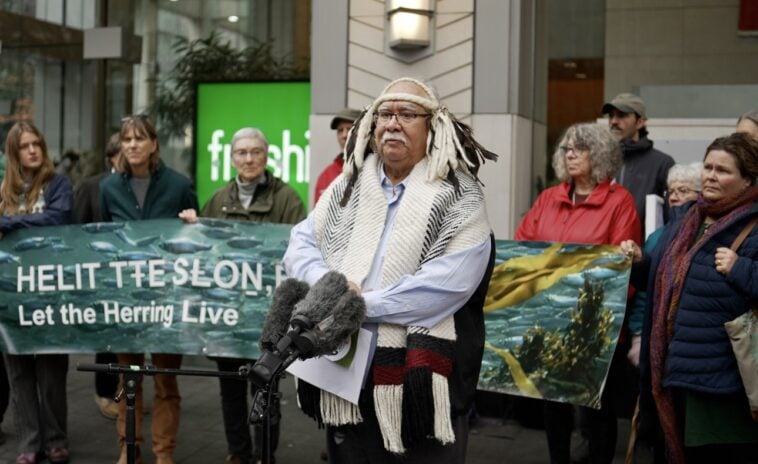
Pelkey has been actively engaged in advocating for herring rehabilitation and in a meeting on Monday with Fisheries and Oceans Canada (DFO) in Vancouver, presented their findings showing how commercial overharvesting and their management have contributed to the herring’s collapse.
“We showed them how, as a result of their own studies, the herring communities that existed all along the coast started slowly dying off because the opening of the commercial fishery was erasing that territory,” Pelkey said.
Pelkey said currently only a few small pockets of herring remain, which their community hope to protect and help recover. However, DFO presents data that shows otherwise. “They say, “That’s not what our science is telling us,’” he said.
Shifting baselines
On Oct. 17, officials released a draft plan for the 2026–27 fishing season, opening it up for a 30-day public consultation. Communities, industry representatives, conservation groups and others were invited to share their feedback. This feedback will be reviewed and used to shape the final harvest plan, expected in early 2026, said Jennifer Young, a DFO media spokesperson.
“Where stocks are at lower levels of abundance in other areas, commercial fisheries have been more restricted or closed.”
Jennifer Young, Media Spokesperson for DFO
She told Canada’s National Observer in an email response that the Strait of Georgia herring stock remains in the “healthy” zone and is managed using a science-based approach that keeps spawning levels above conservation limits. Within the Strait, fishing takes place only when and where large groups of spawning herring are present, while areas with fewer fish, such as the southern Gulf Islands and the Sunshine Coast, remain closed to protect weaker spawning grounds, she said.
The herring stocks in the Prince Rupert District and along the west coast of Vancouver Island are also in the healthy zone and could support carefully managed commercial fisheries. “Where stocks are at lower levels of abundance in other areas, commercial fisheries have been more restricted or closed,” she said.
“We can’t keep allowing the computer programs and algorithms to determine policy in the face of what you can see on the ground…I have to say, there should be no more commercial [fisheries], period.”
David Suzuki, Environmentalist
David Suzuki, world-renowned environmentalist and media personality, was part of the rally on Monday. He rejected DFO’s approach to opening herring fisheries.
“We can’t keep allowing the computer programs and algorithms to determine policy in the face of what you can see on the ground,” he told Canada’s National Observer. “I have to say, there should be no more commercial [fisheries], period.”

Suzuki pointed out that it’s outdated to think of all herring as part of a single breeding population. Herring have a behavior called philopatry, meaning they tend to stay loyal to their local spawning grounds and adapt specifically to those areas. In other words, a herring from Haida Gwaii isn’t the same as one from territories like Nuu-chah-nulth, and populations don’t naturally mix or replenish each other across regions. As a result, if herring numbers drop in one area, they can’t be replenished by fish from another, which makes those local populations especially vulnerable to overfishing and collapse. Many have done just that: Overfishing during the mid-1960s, when annual harvests exceeded 200,000 tonnes, led to a stock collapse in 1967 and resulted in a coast-wide fishery closure from 1968 to 1971.
Today, despite drastically reduced DFO quotas often below 8,000 tonnes, actual catches remain significantly lower.
Suzuki added many Indigenous nations such as the Heiltsuk, Haida and Nuu-chah-nulth have confronted the herring crisis and have even taken matters into their own hands to shut down fisheries in their territories due to observed stock collapses. These nations relied on local knowledge and firsthand observations, directly challenging DFO’s models that inaccurately portrayed herring populations as healthy.

Marine biologist and professor at the Institute for the Oceans and Fisheries at University of British Columbia Daniel Pauly said the debate over herring stocks on the BC coast stems from what he calls “shifting baselines.”
The DFO bases its science largely on data from the past two to three decades — a period that began after herring populations had already crashed under industrial fishing. “There is a completely different perception of what the abundance might have been,” Pauly said.
“These stocks are very present in the stories of the First Nations — they relied on them for hundreds of years, and they’re very present in their stories and their lives. Whereas in the scientific literature, they don’t show up.”
Daniel Pauly, Marine Biologist and Professor at the Institute for the Oceans and Fisheries at University of British Columbia
He said government scientists rarely consider historical or Indigenous accounts because doing so would reveal the full extent of overfishing.
As a result, he said this has created a skewed perception in which the surviving small populations are treated as the baseline, erasing the memory of the much larger and more abundant stocks that existed before industrial fishing.
“These stocks are very present in the stories of the First Nations — they relied on them for hundreds of years, and they’re very present in their stories and their lives. Whereas in the scientific literature, they don’t show up.”
Pauly said fisheries management is heavily influenced by political interests, often favouring industrial players like BC billionaire Jim Pattison and his associates, who control access to BC’s herring fisheries, as a result sidelining Indigenous rights and ecological sustainability.
Not just humans
Rebuilding those depleted stocks through moratoriums or closures would not only revive the herring but restore balance to the entire marine food web that depends on them — from salmon to whales and seabirds.
“Anybody who has ever caught a salmon, cut it open, and opened its stomach will find it filled with herring. It’s not just humans that need the herring. It’s all the rest of the ecosystem,” Suzuki said.
“They all depend on herring to live. Without that, then you wonder why we don’t see the salmon anymore, because there’s no more herring.”
Eric Pelkey, Hereditary Chief of the Tsawout of the W̱SÁNEĆ Nation
Pacific herring make up significant portions of the diets of key predators: 71 per cent of the lingcod diet, 62 per cent of the Chinook salmon diet and 58 per cent of the coho salmon diet consist of herring.
Pelkey said that the decline in herring has caused the disappearance of salmon, seals and killer whales in the region as these species also all depend on herring to survive.

“They all depend on herring to live. Without that, then you wonder why we don’t see the salmon anymore, because there’s no more herring,” Pelkey said.
The WSÁNEĆ hereditary chiefs are currently seeking a legal opinion with the support of conservation groups to determine whether a court challenge based on their Douglas Treaty rights could halt commercial herring fishing in the Strait of Georgia.
“We want it [fishery] to be stopped. It’ll be such a beautiful place for everyone … we’ll be able to leave it alone and let it be.”
Eric Pelkey, Hereditary Chief of the Tsawout of the W̱SÁNEĆ Nation
Jim Shortreed, president of the Herring Conservation and Restoration Society, supporting the chiefs, said that while the legal opinion is costly (expected to cost about $30,000) and not a lawsuit itself, it will assess the chances of success if the matter proceeds to court.
The review follows their 2024 declaration calling for a moratorium to give overwintering and migrating herring refuge from constant commercial fishing pressure. Community donations have fully funded the legal work, which is expected to be completed by spring.
“We don’t have the money to fight this in court, but we see there are other people willing to support us,” Pelkey said. “We want it [fishery] to be stopped. It’ll be such a beautiful place for everyone … we’ll be able to leave it alone and let it be.”