
 Local Journalism Initiative
By Natasha Bulowski, Local Journalism Initiative Reporter, Canada’s National Observer
Three Liberal ministers are maintaining the Liberal caucus is united, despite the recent resignation of former cabinet minister Steven Guilbeault and discontent among BC Liberal MPs whose constituents balk at the idea of a pipeline to BC’s coast.
“The caucus is supportive of the entire MOU.”
Tim Hodgson, Minister of Energy and Natural Resources
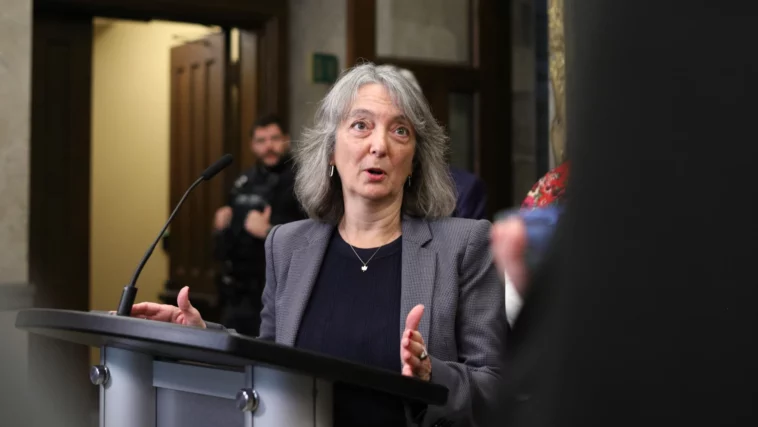
At a chaotic press conference this morning, Minister of Energy and Natural Resources Tim Hodgson and Minister of Environment, Climate Change and Nature Julie Dabrusin were pressed repeatedly on the caucus divisions caused by the Alberta-Ottawa agreement to work towards building a new pipeline. Dabrusin and Hodgson maintained there is no division and the caucus is united.
“The caucus is supportive of the entire MOU,” Hodgson said.
This all comes on the heels of Guilbeault resigning from his cabinet post over the Alberta-Ottawa MOU — a deal that was widely criticized by climate experts as capitulating to Alberta Premier Danielle Smith by exempting the province from climate regulations, including the Clean Electricity Regulations. Guilbeault described the so-called “grand bargain” with Alberta as a “fire sale” in a recent open letter published in the Toronto Star.
Guilbeault isn’t alone in his stated opposition to the MOU within the caucus. Victoria Liberal MP Will Greaves previously told Canada’s National Observer his constituents are almost universally opposed to the MOU’s proposal to build a pipeline and lift the oil tanker moratorium.
Dabrusin told reporters she disagrees with Guilbeault’s characterization of the MOU; the closest Dabrusin came to acknowledging any division within the party was to say in French that the whole caucus is interested in fighting climate change and there are some different ideas about how to do so.
“If we vote yes … it looks like we are undermining the rights of Indigenous peoples. It looks like we’re undermining conversations with BC. It looks like we are ignoring the rest of the major environmental actions that are part of this MOU. And if we vote no, well, it’s designed to look like we don’t support the pipeline, and we do support the pipeline.”
Corey Hogan, Alberta Liberal MP
Later today, MPs are set to vote on a non-binding Conservative motion that draws on language from the Alberta-Ottawa agreement and states explicit support for “the construction of one or more pipelines enabling the export of at least one million barrels a day of low-emission Alberta bitumen from a strategic deep-water port on the British Columbia coast to reach Asian markets” and “an appropriate adjustment to the Oil Tanker Moratorium Act, while respecting the duty to consult Indigenous Peoples.”
At a press conference this morning, Alberta Liberal MP Corey Hogan said the motion is a trap for the Liberals but that voting no is the best option.
“If we vote yes … it looks like we are undermining the rights of Indigenous peoples. It looks like we’re undermining conversations with BC. It looks like we are ignoring the rest of the major environmental actions that are part of this MOU,” Hogan said. “And if we vote no, well, it’s designed to look like we don’t support the pipeline, and we do support the pipeline.”
“The pipeline is in the MOU. We support the entire MOU.”
Conservative motion ‘not a vote for the MOU’
The Conservative motion lifts some language directly from the Ottawa-Alberta MOU, so Conservative Leader Pierre Poilievre and his MPs argue if the Liberals truly support building a pipeline, they should have no problem voting for the motion.
The vote is tracking for 5:45 p.m. ET, according to Conservative Leader Pierre Poilievre’s director of communications, but that timing could change.
Hodgson said the Liberal caucus will vote against the motion, calling it a “cynical ploy to divide us” and “a cheap political stunt,” in a press conference on Tuesday morning. Minister of Indigenous Services Mandy Gull-Masty said, in her view, the motion is “disrespectful to Indigenous people” because its wording only references “consultation” instead of acknowledging that much more needs to go into the process.
This is “not a no vote for the MOU. It’s a no vote against the Conservatives playing games and creating optics and wasting parliamentary time,” Gull-Masty said.
“It’s a party that would not respect the rights of neighbouring jurisdictions. Our Prime Minister has been clear: We’re going to need to see the agreement of British Columbia, we’re going to need the agreement of Indigenous peoples. There, in this motion, they don’t include that.”
Julie Dabrusin, Minister of Environment, Climate Change and Nature
Similarly, Dabrusin said the motion leaves out critical wording from the deal, which obligates Alberta to tackle climate change through changes to the industrial carbon price.
This motion is reflective of the Conservative Party’s stance, Dabrusin said.
“It’s a party that would not respect the rights of neighbouring jurisdictions. Our Prime Minister has been clear: We’re going to need to see the agreement of British Columbia, we’re going to need the agreement of Indigenous peoples. There, in this motion, they don’t include that,” she said.
“This motion refuses to talk about climate change, any kind of commitment towards getting to net zero.”
“We believe Canada needs a pipeline to the Pacific and that we need to override the discriminatory anti-Canada ban on shipping Canadian energy overseas.”
Pierre Poilievre, Conservative Leader
Just after noon, Poilievre made an amendment to the motion to add large sections of the MOU to include greenlighting the Pathways Alliance’s proposed carbon capture and storage project, further engagement with British Columbia, work on electricity grid interties and economic opportunity for Indigenous people including through ownership.
“We believe Canada needs a pipeline to the Pacific and that we need to override the discriminatory anti-Canada ban on shipping Canadian energy overseas,” Poilievre said in the House of Commons. The tanker ban only applies to large oil tankers from the northern tip of Vancouver Island up to Alaska. BC Coastal First Nations, including council president of the Haida Nation Gaagwiis Jason Alsop came to Ottawa on Tuesday to oppose the Conservative motion.
Poilievre’s amendment did not include any reference to industrial carbon pricing, which Liberal MPs immediately took issue with during debate in the House of Commons.
In the House of Commons, Hogan said he wondered how Poilievre can reconcile “emphatically” opposing the industrial carbon price while also supporting the Pathways project when that mechanism is a key condition to create a business case for major carbon capture projects.