 Local Journalism Initiative
By Sonal Gupta, Local Journalism Initiative, Canada’s National Observer
A BC First Nation chief is calling on governments to consult affected Nations after Roberts Bank, situated near the US-Canada border, became a focal point for port expansion and Alberta’s proposed oil route to the Pacific.
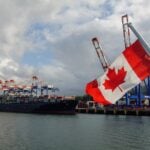
The chief’s concerns come following two major announcements from federal and provincial governments. Last week, the federal government committed up to $10 billion for upgrades at the Roberts Bank shipping terminal, south of Vancouver, saying the added ship capacity would enable $100 billion in new trade. Later the same day, Alberta announced a separate proposal for a new oil pipeline from Bruderheim (near Edmonton) through southern BC that would end at Roberts Bank.
Shana Thomas, hereditary chief of the Lyackson First Nation, told Canada’s National Observer building Alberta’s pipeline to Roberts Bank would move more shipping pressure into the Salish Sea, where it could affect the Nation’s harvesting, cultural practices, stewardship responsibilities and rights.
One area of concern is Leey’qsun Island, commonly known as Valdes Island, the nation’s ancestral homeland and home to its three reserves. Thomas described it as roughly 32 to 34 kilometres west of Roberts Bank, “a dead shot” across the water.
She said impacts from increased shipping or a spill would not stay at Roberts Bank because tides, currents and marine species move through the Salish Sea. “The water is really this whole ecosystem,” she said. “It’s all interconnected.”
Lyackson has already seen how material from the water can end up on the island, she said. Debris has washed onto the island before, which is why the First Nation is concerned about currents carrying pollution or oil from increased marine traffic toward its shores.
“If there were any challenges, as we know, there’s science that tells us [that] it’s not if, it’s when, there will be a spill,” Thomas said. “What would that mean?”
Past concerns resurface
Robert Banks is a major port area in Delta, already home to Canada’s largest container terminal and a major coal export facility. Roberts Bank Terminal 2 is a planned new container terminal beside the existing port complex.
Lyackson participated in a lengthy federal review of Roberts Bank Terminal 2, which began in 2013, where Thomas said the First Nation raised concerns about increased vessel traffic, anchorages, lights, underwater noise and impacts to marine habitat. Those concerns have grown as large vessels have become more visible around Lyackson and nearby Southern Gulf Island communities.
“We’re seeing a lot of anchorages that we wouldn’t have seen before,” Thomas said. “Sometimes there’s like five to 10 of them there.”
She said anchors can drag across the seabed, while vessel noise and lights can affect marine life, including southern resident killer whales. When marine traffic briefly dropped during COVID-19 restrictions, Thomas said killer whales returned to areas where vessel noise and activity had eased.
The federal government approved Roberts Bank Terminal 2 in 2023 even after the review found the project was likely to cause significant environmental harm. The approval came with conditions, including monitoring, measures to reduce impacts on fish, birds and marine mammals and continued consultation with Indigenous groups.
Other First Nations are also seeking details. Tsawwassen First Nation, whose territory includes Roberts Bank and whose Treaty Settlement Lands may be affected by the proposed southern route, said it has not been consulted and has not taken a position. “If this project proceeds, we expect to be meaningfully involved from the earliest stages of planning and decision-making,” executive councillor Valerie Cross said in a press release.
In an emailed response to Canada’s National Observer, a spokesperson for Musqueam Indian Band said it recently learned of Alberta’s pipeline proposal and understands the preferred southern route would cross its traditional unceded territory. The nation said it is open to talks on economic opportunities, but needs to know how spill protection and marine safeguards would protect its lands and waters.
“For generations, we have been the stewards of the Fraser River and we take our role very seriously,” the spokesperson said.
Roberts Bank has drawn cross-border Indigenous opposition. In 2023, Lummi Nation in Washington state filed a judicial review in Federal Court seeking to quash Canada’s approval of Roberts Bank Terminal 2, saying Canada failed to consult and accommodate the nation over potential impacts to its rights. Lummi has said its traditional fishing grounds extend into what is now Canadian territory.
Thomas said the announcement suggests governments still have not learned from past pipeline and port battles: First Nations should be involved before major decisions are made, not after deals are announced and nations learn about them through the media. She pointed to the 2025 BC Supreme Court decision in the Cowichan title case, as well as BC and federal commitments to implement the UN Declaration on the Rights of Indigenous Peoples.
“It’s infuriating that in 2026, after everything we’ve been through, this is still what’s happening,” Thomas said. “Governments are making announcements and First Nations are an afterthought.”