 T.A. Stafford
From Burning Rivers to Blackened Shores — A Warning from the Woman Who Tried to Clean It Up
by T.A. Stafford
A river in Ohio caught fire thirteen times before anyone bothered to photograph it.
The river. The fire. That was the price of progress.
Finally, in 1969, it made national news. The Cuyahoga; thick with industrial waste, oil slicks, and raw sewage from decades of unchecked pollution; ignited like a gasoline spill. Fireboats were useless against water that was itself fuel.
The image traveled everywhere: flames, some of them five stories high, rising from a river that should have been impossible to burn.
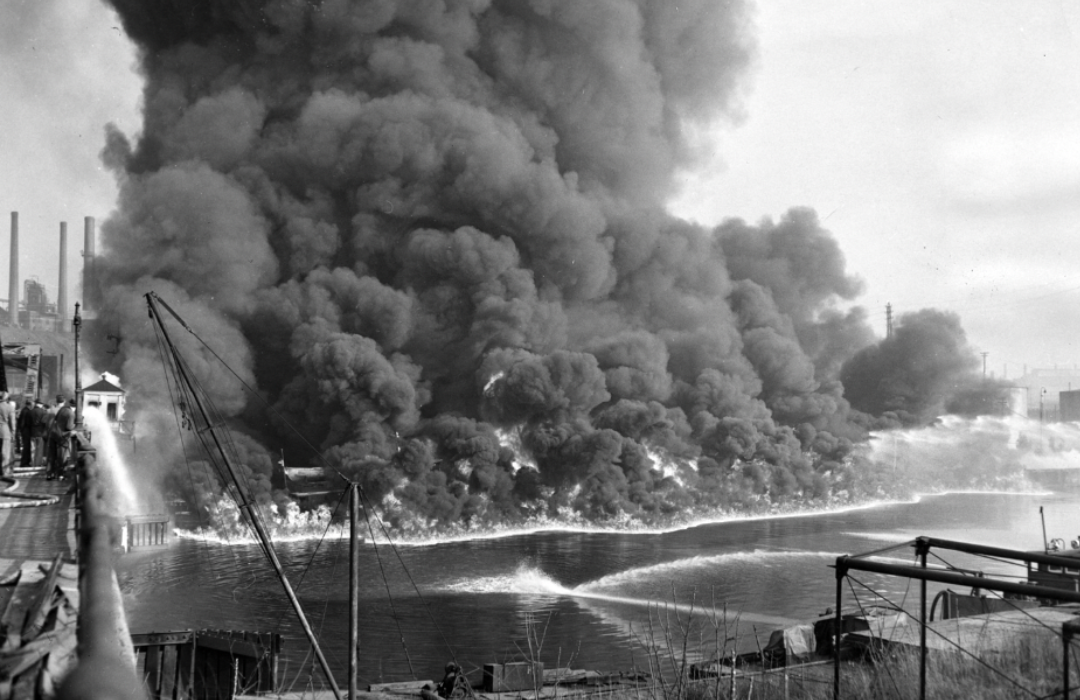
When Anita Burke was young, she didn’t need a photograph to know what a burning river looked like. She grew up in Ohio. She saw them.
And the images stayed with her.
“I grew up watching the rivers in Ohio on fire,” she would say decades later. “And I became a little obsessed. And then from there, completely committed to being, what I called an ‘earth surgeon’. Those fires. They weren’t right. I wanted to heal the earth, medicate it and cut out the toxic stuff that was making it sick. I wanted to filter the toxins out and put them back, just like you do with a blood transfusion in a human body.”
The image forged her identity. She knew she wasn’t going to be able to fix the problems with words or with money or with Band-Aids. She was going to have to treat the earth’s injuries directly: stop the bleeding, restore the flow, get the system working again.
In her mind it was triage: you always treat the worst injuries first – which led her to an 18 year stint in the oil business – cleaning up the industry’s worst messes.
That same triage mindset, it turned out, was also perfect for solving puzzles, and a contaminated site was just a giant puzzle to be solved – a puzzle with many moving parts: regulations, geology, chemistry, community pressure, and corporate liability. She’d walk into a mess that everyone else saw as a disaster and see something else: an organism that could be reconfigured.
She became known as a fixer. Someone you called when things went bad. And she saw bad. Things that would make your blood curdle.
But nothing prepared her for what was to come.
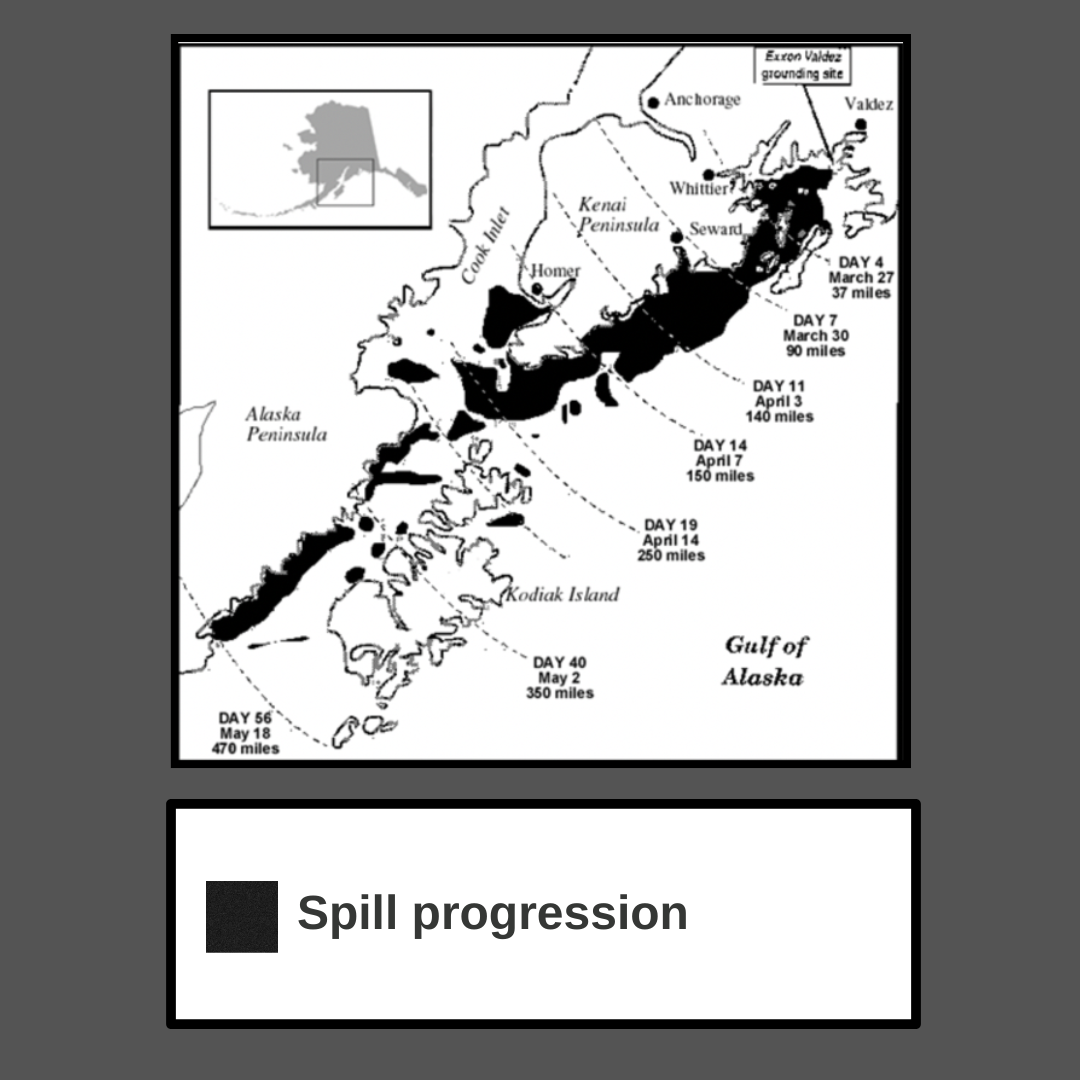
On March 24, 1989, just after midnight, the Exxon Valdez ran aground on Bligh Reef in Prince William Sound. Anita didn’t know that yet.
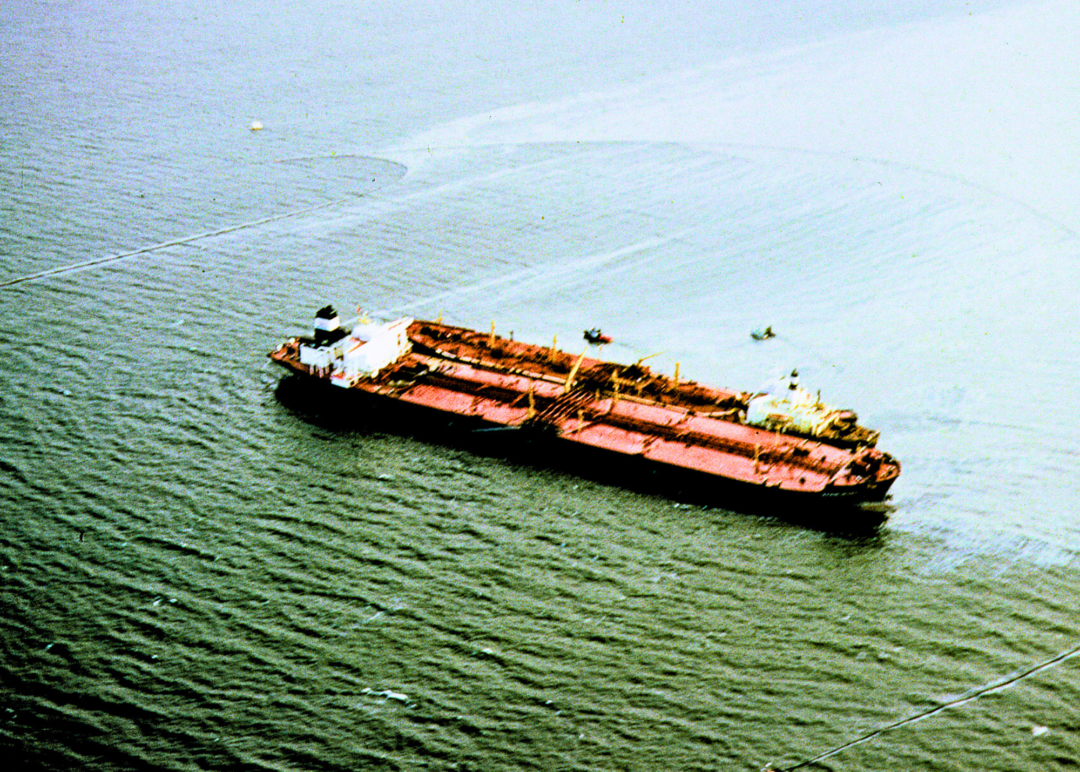
Hours later, she was in her living room, moving through her morning routine. Sunlight through the windows. Her son asleep upstairs. The quiet before.
The news broke before she’d finished exercising that morning.
She saw it on the television: the aerial footage, the ship listing, the black ribbons unfurling across water so clear you could see fifty feet down. Eleven million gallons. Gushing. She stopped. Hand on the floor, mid-stretch, and didn’t move.
Her son was four. She went upstairs and woke him. He sat up, groggy, still holding the stuffed otter he slept with every night. The one with the worn fur where he rubbed it against his cheek. She sat on the edge of the bed and told him she had to go. Something terrible had happened. A boat had broken open. The water was full of oil. Animals were hurt. Beaches covered.
He looked at her. Then he looked down at the otter in his arms. Held it a little tighter. He was quiet for a moment. Then he said, “It’s okay, Mommy. So long as you’re going to save the otters first, you can go.”
She didn’t cry then. She would later.
Within hours, she was on a helicopter to Prince William Sound.
The helicopter dropped her into a world she didn’t recognize.
The sound first: the thrum of engines, the crackle of radios, the constant mechanical roar of men trying to outshout a disaster. Then the smell. It hit her before she was on the ground: crude oil, sharp and chemical, but underneath it something sweeter, thicker. The smell of things dying.
“Sea otters, their fur matted with crude, hypothermic and dying on beaches they’d inhabited for generations, seabirds encased, unable to fly or float, dying where they sat. Killer whales surfacing in slicks, their blowholes clogged.”
Anita Burke
Then she saw the water.
It wasn’t water anymore. It was a black sheet stretching to the horizon, heaving with the tide, slick with rainbows where the light caught it. The shoreline was the same: rocks coated, kelp forests drowned, beaches turned to something that looked like asphalt.
She walked the edge of it. The oil pulled at her boots. Each step made a tearing sound.
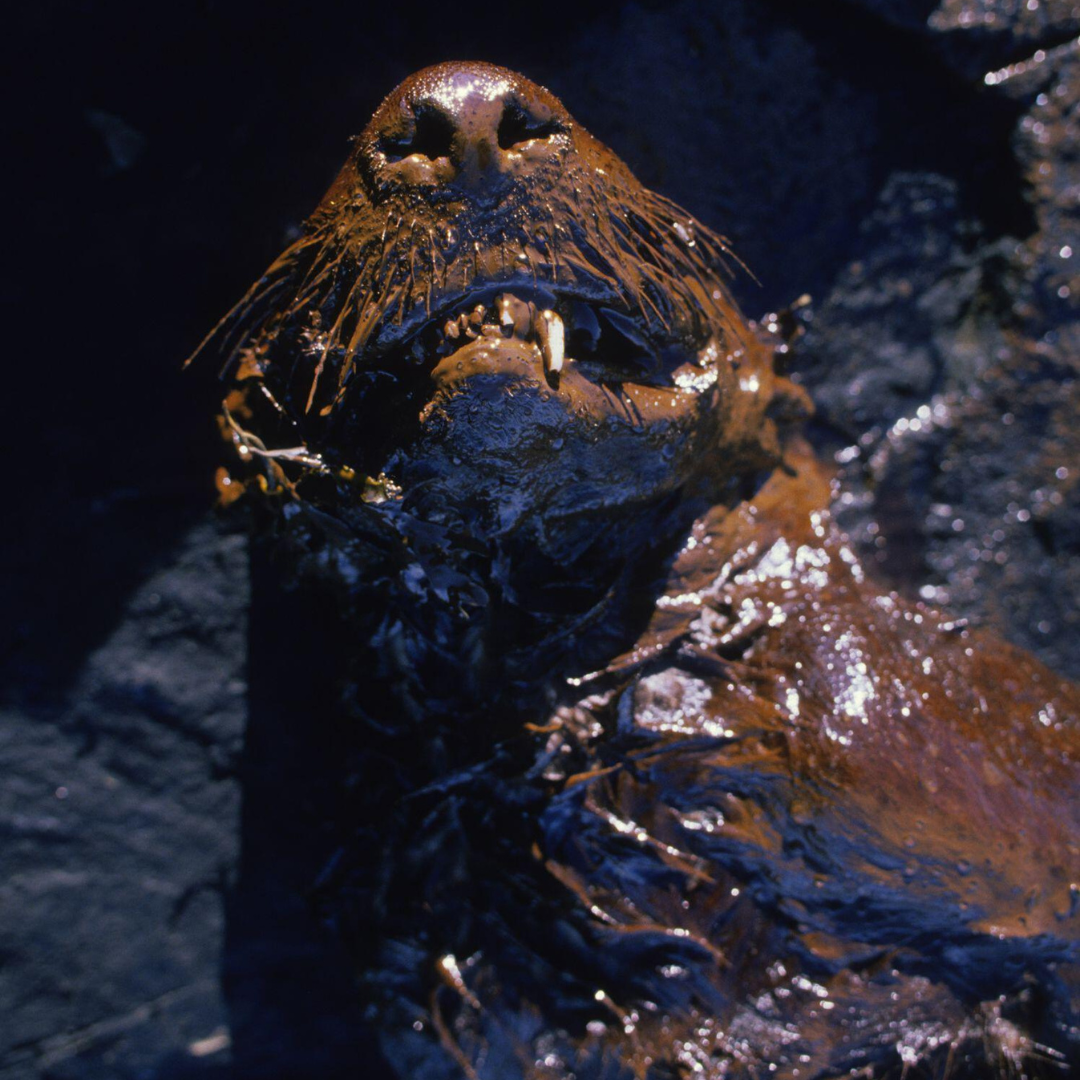
The animals were everywhere and nowhere. “Sea otters, their fur matted with crude, hypothermic and dying on beaches they’d inhabited for generations,” she would recall. “Seabirds encased, unable to fly or float, dying where they sat. Killer whales surfacing in slicks, their blowholes clogged.”
She learned quickly not to look for too long. But she couldn’t stop. Her job now was designing the program for everything the cleanup generated, the oily waste, the contaminated materials. “The carcasses of dead animals, thousands of them, piling up faster than anyone could process.”
The cleanup was chaos. Exxon had no plan. The Coast Guard had no plan. Nobody had ever tried to clean up something this big. They didn’t have the tools and so they had to improvise. Every day they invented something new.
“We were inventing response strategy daily,”
Anita Burke
She stood in Mears Cove, a small inlet about the size of a two-car garage, watching men try to scrub oil from rocks with a contraption rigged from mountain bike tires. That was the technology they had. Mountain bike tires and a shaking thing, trying to wash stones clean. One by one. Rock by rock. In a cove the size of a garage, along a coastline that stretched for thousands of miles.
“We were inventing response strategy daily,” she would recall. There were no manuals for this. No playbook. Every morning brought some new problem no one had anticipated, and every afternoon they tried to build a solution out of whatever was lying around.
The waste alone was a nightmare. Everything the cleanup generated – the oil-soaked booms, the contaminated gravel, the carcasses – had to go somewhere. They built a pit for it. A land pit right on the beach, lined with plastic, about the size of two football fields.
And she was in charge of it.
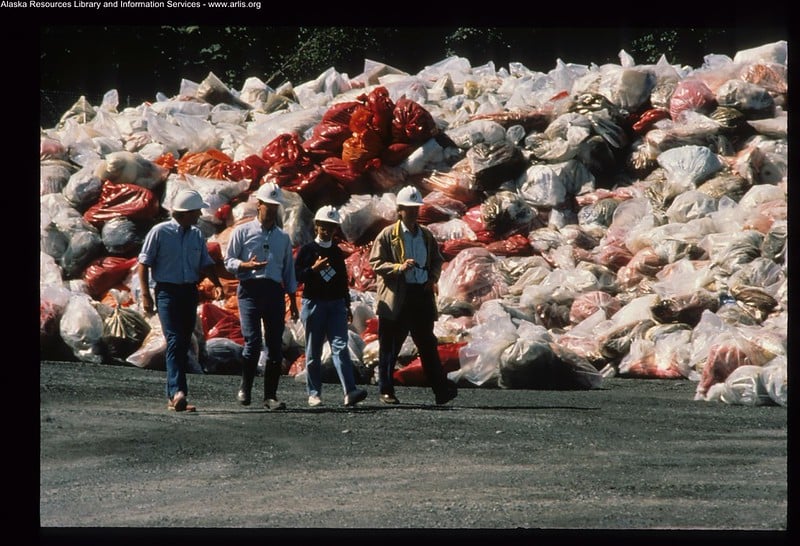
Of course, winter was coming. They’d been there forever. Nobody had thought about winter. She remembers standing there, looking at the pit, realizing what was about to happen. It was lined, it wasn’t leaking but winter was coming. The snow would fill it. The rain would fill it. All that toxic water would have nowhere to go. The whole thing would become a poison lake, and then what? Would it breach? Would they have to start all over?
She looked at the berm on the south side. She looked at the liner. And she said, “Here’s what we’re going to do. Cut the berm. Fold the liner over on itself. Seal the edges. Turn the whole thing into a giant taco. A giant fucking taco.” she called it. “Modified taco engineering design. Let it sit through winter, sealed up tight. Come spring, split it open, haul everything out.”
Luckily it worked. That’s what they had to do. Make it up as they went.
But the taco was just one corner of one cove. The oil was everywhere else. It had sunk into the gravel. It had soaked into the intertidal zone. It had coated the rocks and the kelp and the feathers and the fur. They could scrub and dig and seal and haul, but they could never reach it all.
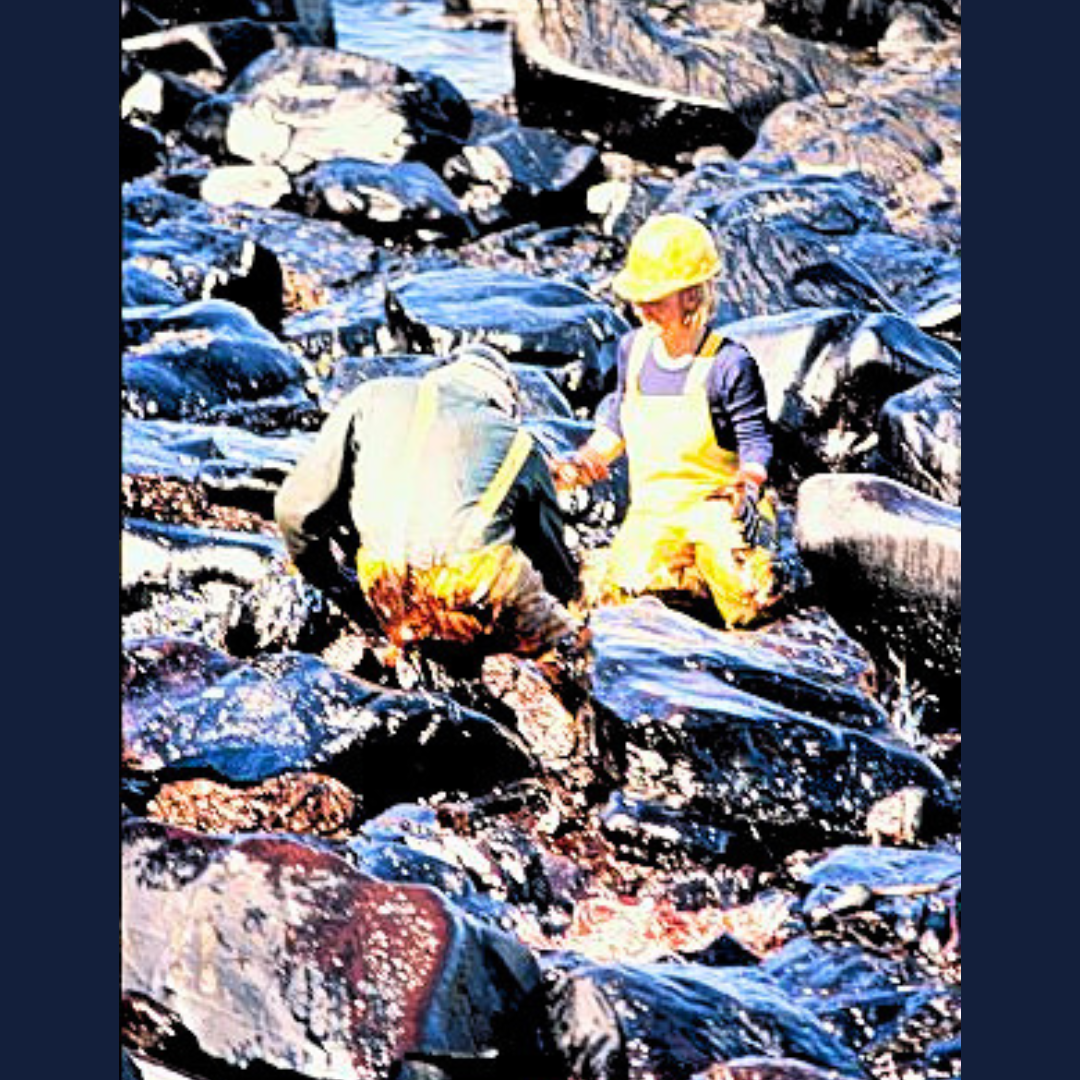
She would learn years later that she was right. “There’s still oil on the beach,” she would say. “It’s just a layer of asphalt now because of the cold and time, but you can go along the beach and dig down a couple feet and there she is.”
And not just on the beach. Thirty-seven years later, the oil is still everywhere. The impacts are subtle now, but they’re serious. The fisheries feel it. Herring populations never recovered. The salmon runs are different now. Decades later, the toxic legacy persists. Even when salmon return in number, the exposure to leftover oil still causes a chemical time bomb in their eggs – weakening hearts, warping spines, and ensuring that survival is never what it used to be.
“There was no way for me to ever get all of it cleaned up.”
Anita Burke
And then there’s the otters that were supposed to be saved first.
She remembers the otter. Her son’s stuffed one, worn fur against his cheek. The real ones, floating belly-up, their fur so matted with crude they looked like stones. She had told him she would save them. She had promised.
She couldn’t. Not all of them. Not even most. She couldn’t get it all clean. The wound was too big, and she was standing in a cove the size of a garage with a rock washer made from mountain bike tires.
And there, in that tiny cove, the truth of it settled in her. “There was no way for me to ever get all of it cleaned up.” Here was a wound she could not close.
The puzzle, for the first time in her life, seemed unsolvable.
After Valdez, Anita could have walked away. Instead, she moved deeper in.
The oil companies were the ones with the biggest toxic debacles. That meant they were also the places where she could have the biggest impact. She went from consulting to working directly for them, first at Texaco, then at Shell.
By 1998, she was head of sustainability and climate policy worldwide for Shell International. She was flown around the world to speak at conferences, to meet with environmental groups, to stand on stages and explain how a major oil company could be a force for good.
And for a while, she believed it.
“For years the company celebrated me, they promoted me, they said keep doing what
Anita Burke
you’re doing.”
When communities were angry; when Shell had clearly done damage; they sent Anita. Not because she was good at PR, but because she was good at listening. “I never went into those situations with a recipe for how we could get away with what we’ve done,” she explains. “My objective was to find out how everyone was harmed.”
Her approach was simple: if the company was clearly on the hook, you quit fighting. You step in. You solve it.
And for a time, it worked. “People heard me, trusted me, calmed down, and ultimately became my biggest supporters,” she recalls. “For years the company celebrated me, they promoted me, they said keep doing what you’re doing.”
She believed the system could be healed from within.
But it was a belief she would have to unlearn.
Shell had made a commitment to protections, emissions reductions, stewardship. A real one, she thought. But times were changing. And when a new leader arrived, all of it – the promises, the progress, the years of work – was just another line item to cut.
“When the awareness hit me that this wasn’t a core value, this was just a public relations maneuver, I had a…a big breakdown.”
Anita Burke
When the commitments became inconvenient. When the time came to make good on them, the company bailed. They walked away like they had never been made. And they asked Anita to go back out into the world and tell everyone she still believed in them. To become the face of something she knew was a lie.
She said “No. I ain’t doing that.”
“When the awareness hit me that this wasn’t a core value, this was just a public relations maneuver, I had a…a big breakdown.”
Everything she had built; her identity, her purpose, the story she had told herself about turning wrong into right, being trusted by the corporation and by the public, was shattered. She had believed she was inside the machine, steering it toward something better. But the machine had no interest in being steered. It had only ever been using her.
“Shysters and thieves,” she would call them. She saw the industry clearly for the first time. Not as a collection of flawed people trying to do better, but as a system built to avoid accountability. Well, not all accountability – shareholders were important. Just any accountability that sacrificed profits.
She had watched Shell spend millions cleaning up their own messes. But it was the Exxon Valdez that showed her the full cost of what they were willing to leave behind, willing to destroy: Eleven million gallons into Prince William Sound. Thousands of miles of coastline coated. A fishing industry shattered overnight – populations that have never recovered. And then the cleanup: $2.2 billion, 11,000 workers, 1,400 vessels, 85 aircraft. A waste pit the size of two football fields…and still only a 10% recovery.
And she watched what came after. The Prestige off Spain – 20 million gallons. The Hebei Spirit off Korea – 3 million gallons. The Montara off Australia – a wellhead that blew for 74 days before it was capped. The Taylor Energy platform in the Gulf of Mexico that was supposed to be sealed but actually leaked a million gallons – maybe more – for fifteen years without anyone saying a word.
And then came Deepwater Horizon, off the coast of Louisiana – more than 200 million gallons. BP spent $14 billion on cleanup, deployed 47,000 workers and 7,000 vessels, and still, they had no idea what to do. For 87 days, they made it up on the fly. They tried stuffing the well with golf balls, shredded tires, knotted rope – anything to clog the hole. Engineers called it a “junk shot.” It failed. They tried again. It failed again.

The truth was the same as it had been in Mears Cove: when the wound is that big, you don’t have a plan. You just stand in the mud and figure it out. Or you don’t.
The system wasn’t built to prevent disasters. It was built to absorb them and keep moving.
“When anybody tells you that they have technology to solve whatever appears, they are lying to you. We are making it up on the fly.”
Anita Burke
When she hears about new pipelines or tanker ports, like the one proposed not far from where she now lives in southern Alaska, her reaction isn’t what people expect. She doesn’t just protest. She almost laughs.
“You f***g idiots. Go for it. It’s going to take you ten years to plan it. It’s going to take you fifteen years out, engineering it. Given the volatility on the planet, you think you’re going to dig a port and build a pipeline?”
And she arms communities with questions instead of slogans. “Ask them: are your spill response technologies pre-approved by the government agencies? Have they been tested in the field? Give me a list. Because all we know about is Corexit (dispersant) and booms and skimmers. That’s the best y’all got. If you got new stuff, we sure might take a look at it.”
Because here’s the truth she learned in Mears Cove, standing in a two-car-garage-sized inlet with a rock washer made from mountain bike tires: “When anybody tells you that they have technology to solve whatever appears, they are lying to you. We are making it up on the fly.”
The technologies that worked in Prince William Sound were ditch digging and the modified taco. Not high-tech solutions. Not pre-approved systems. Just a woman standing in the mud, looking at what was in front of her, and figuring it out.
She still does that. Just in different places now.
The only way to stop it from happening again is to look at what happened before. Really look. At the rivers burning. At the otters floating belly-up. At the promises that were never going to be kept. And to ask the questions they don’t want you to ask.
The little boy with the stuffed otter is a man now. He has his own life, his own puzzles.
But she still remembers the promise she made to him that morning: the otters first.
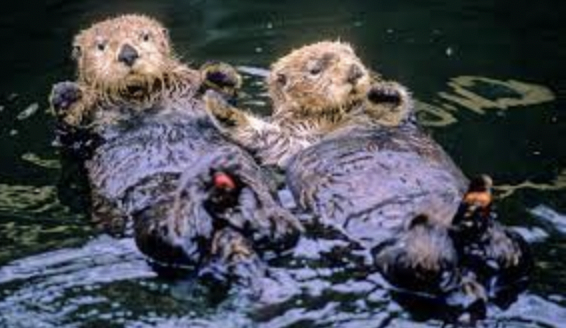
She’s still trying to figure out how to keep it.