
 Local Journalism Initiative
By Crystal St.Pierre, Local Journalism Initiative Reporter, Windspeaker.com
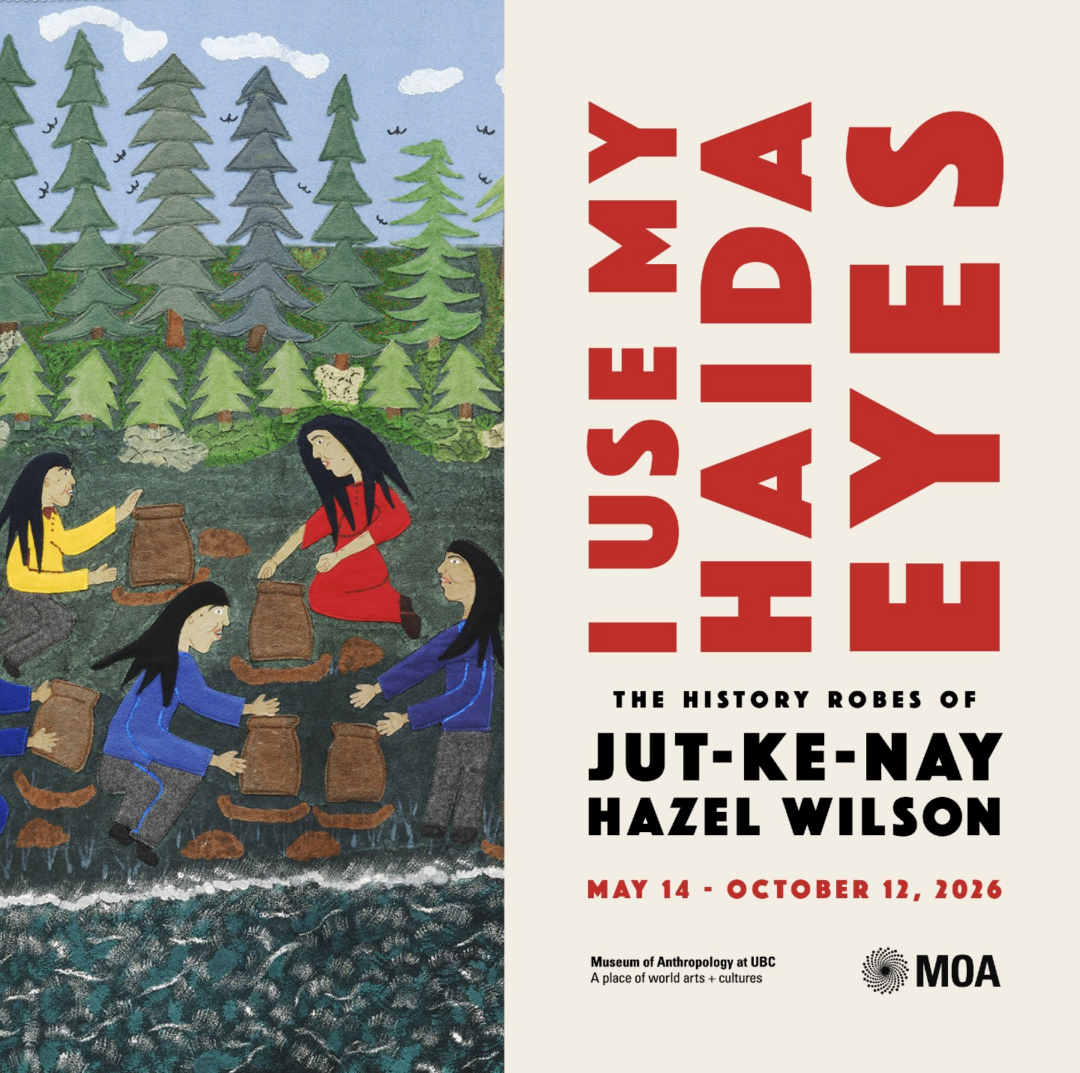
The Museum of Anthropology at the University of British Columbia will present the exhibit I Use My Haida Eyes: The History Robes of Jut-ke-Nay—Hazel Wilson from May 14 to Oct. 12.
Wilson spent a lifetime creating art reflecting Haida culture, and from 2005 to 2006 she created a series of robes. They were the subject of a 2022 book Glory and Exile: Haida History Robes of Jut-ke-Nay Hazel Wilson, which was published by Figure 1 Press and the Haida Gwaii Museum.
“She made 51 of these (robes) and they are being shown or presented in this exhibition as a whole series for the first time because they’ve never been shown as a complete body of work,” said exhibition curator ɬəkʷəlqinəm Jordan Wilson.
“These history robes are unique in a number of ways because she’s expanding on the form of the ceremonial garment, or robe known as a button blanket, which typically would be embellished with the imagery of an individual or the crest imagery of an individual’s clan or family.”
ɬəkʷəlqinəm Jordan Wilson, Exhibition Curator
The series includes 50 of the robes (one is in a private collection and was unavailable to be borrowed), each handmade to reflect Haida perspectives, including narratives of her Haida ancestors, settler colonial acts of oppression, as well as Wilson’s own childhood memories of gathering and harvesting on the Haida Gwaii territory.
“These history robes are unique in a number of ways because she’s expanding on the form of the ceremonial garment, or robe known as a button blanket, which typically would be embellished with the imagery of an individual or the crest imagery of an individual’s clan or family,” explained ɬəkʷəlqinəm.
The Haida are First Nations from the Pacific Northwest Coast with deep spiritual traditions and a strong connection to land and sea. Haida Gwaii is a group of islands off the coast of British Columbia and Alaska.
Closely tied to the ocean, forests and wildlife, the community has two main clans—Raven and Eagle. It’s a matrilineal society so clan association passes through the women.
“I was filled with wonder when I first encountered Hazel’s series of history robes, as they pull you into Hazel’s world and are innovative and unexpected in their form. They have an intimate and moving quality, while being far-reaching in their historical depth.”
ɬəkʷəlqinəm Jordan Wilson, Exhibition Curator
Haida art is distinctive and typically features shapes representing such beings as ravens, eagles, bears and killer whales. This imagery holds symbolic meaning, whether carved on totem poles, jewelry or found on ceremonial button blankets or robes.
“I was filled with wonder when I first encountered Hazel’s series of history robes, as they pull you into Hazel’s world and are innovative and unexpected in their form. They have an intimate and moving quality, while being far-reaching in their historical depth,” said ɬəkʷəlqinəm.
“Twenty years after its creation, this body of work continues to resonate, particularly in depicting a Canadian colonial history, whose legacies Indigenous peoples and settlers alike have inherited,” he said. “The series also portrays the Haida peoples’ deep and ongoing connection to their territory. In bringing together this full series for the first time, this exhibition opens up a larger conversation about Indigenous values and environmental stewardship within our capitalist society’s extractive approach to land and resources.”
“We will be showing a selection of those handwritten stories and also reproducing some of them in text on the walls.”
ɬəkʷəlqinəm Jordan Wilson, Exhibition Curator
The exhibit will feature handwritten text by Hazel Wilson explaining the robes’ meaning.
“She wrote out these one-to-two-page long narratives about what is being depicted in the robe,” said ɬəkʷəlqinəm. “We will be showing a selection of those handwritten stories and also reproducing some of them in text on the walls.”
Wilson’s two daughters, Dana and Avis Simeon, will narrate some of the stories.
“I’ve been really fortunate to have the guidance and advice from two of late Hazel’s daughters who are both based here in Vancouver and have graciously shared a lot of information and stories about their late mom,” ɬəkʷəlqinəm added.
The robes depict stories of Haida ancestors ranging from the pre-contact period to the first contact with Europeans, and include stores from Wilson’s own childhood in the 1940s and ‘50s.
“They’re depicting historical scenes and moments of her lived experience,” Wilson said. Each robe is about five-feet by six-feet.
“They will take up the majority of our largest exhibition space and will be quite immersive for the visitors entering into a world as seen through late Hazel Wilson’s eyes.”
ɬəkʷəlqinəm Jordan Wilson, Exhibition Curator
“Guidance” is the title of one of the robes. It depicts the time when Wilson was approached by her Elders to explain her responsibility to the Haida culture and history by creating button blankets.
“The Mistake” robe shows Haida’s first encounter with European explorers; the “All the Nations Came Together (Putting Away the Magic)” robe depicts Haida and other Indigenous women putting away their ‘magic’ for safekeeping from settlers; and “Tiiyan” shows a night scene from Wilson’s ancestral village.
“They will take up the majority of our largest exhibition space and will be quite immersive for the visitors entering into a world as seen through late Hazel Wilson’s eyes,” said ɬəkʷəlqinəm.
The May 14 opening of I Use My Haida Eyes: The History Robes of Jut-ke-Nay—Hazel Wilson will run from 6 p.m. to 9 p.m. with free museum admission for all. To learn more about the exhibition, as well as ancillary events, visit moa.ubc.ca